
Your AI Chatbot Just Became a Witness Against You
A February 2026 federal ruling made it official: anything typed into a public AI platform is potentially discoverable in court. Here's what that means for your organization — and what to do about it.
Executives and legal teams have spent years debating what employees should and shouldn't type into ChatGPT, Claude, or Gemini. On February 17, 2026, that debate took on a new dimension. A federal judge in the Southern District of New York issued a landmark ruling in United States v. Heppner that should be required reading for every CIO, General Counsel, and compliance officer in the country.
The ruling is simple in its logic and sweeping in its implications: conversations with public AI platforms are not protected by attorney-client privilege or the work product doctrine. If your employees are using commercial AI tools to think through business strategy, legal exposure, personnel matters, or contract negotiations — opposing counsel, federal investigators, or regulators may one day read every word.
What Happened in Heppner
Bradley Heppner was under federal investigation for securities fraud. Without his attorneys' knowledge, he turned to Anthropic's Claude to draft what he called "defense strategy documents." He later shared those documents with his legal team and argued they should be shielded from government inspection.
"This case is a telling reminder that, regardless of your privacy settings, your interactions with AI chatbots and other systems may one day be produced in court." — Cybersecurity News, citing the court's reasoning
Judge Jed S. Rakoff denied Heppner's claim. The court found that because no attorney was involved in the AI conversations, no privilege could attach — full stop. The government was permitted to read every exchange. The court also noted it was unaware of any prior ruling that had addressed this precise issue, effectively making this the first of its kind.
Why This Matters Well Beyond Criminal Cases
Heppner was a criminal case, but the principle extends directly to civil litigation, regulatory investigations, and employment disputes. Whenever an organization is a party to a proceeding, opposing counsel can use discovery to compel the production of relevant documents. If sensitive business discussions occurred on a commercial AI platform — even under a paid enterprise plan — those logs may be reachable.
- M&A due diligence. Deal strategy drafted with an AI assistant becomes part of a dispute over disclosed liabilities.
- Employment litigation. HR leaders who used AI to draft termination rationale face discovery of the full conversation thread.
- Regulatory inquiry. An agency uses a subpoena to access AI conversations about compliance posture and known gaps.
- Contract disputes. Internal AI-assisted analysis of contract weaknesses surfaces during litigation with a vendor or customer.
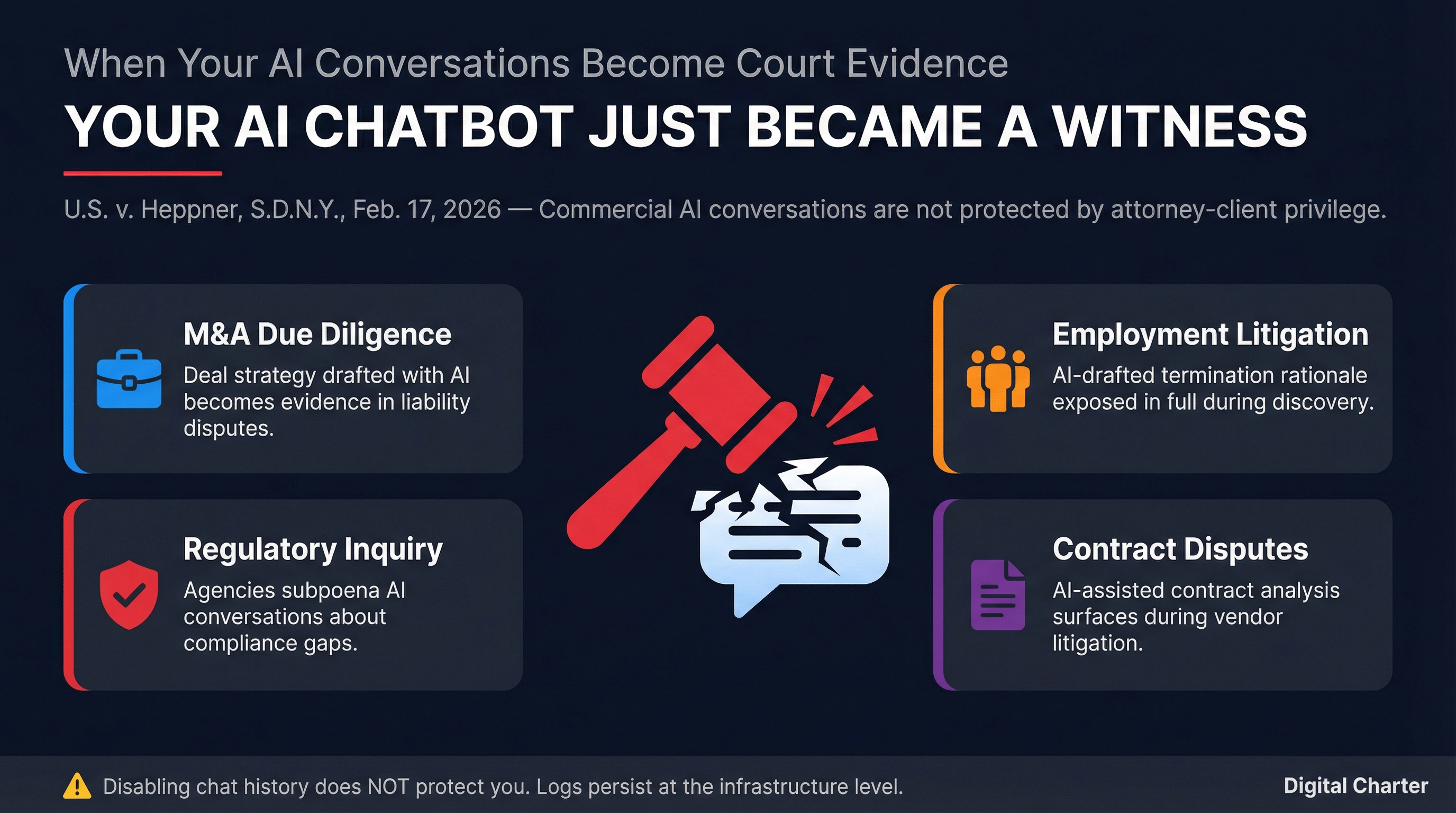
In each scenario, the organization believed it was using a productivity tool. What it was actually creating was a detailed, timestamped record of its internal thinking — stored on a third-party server it does not control.
The "Delete History" Setting Is Not a Legal Shield
Many users believe that disabling chat history in ChatGPT or Claude protects them. It does not. Commercial AI platforms — even those with user-facing privacy controls — maintain logs at the infrastructure level for safety monitoring, abuse prevention, and model improvement purposes. The Heppner court specifically noted that even systems configured to delete user-facing history may preserve conversations in other forms that remain producible.
Using a commercial AI tool is nothing like talking to your attorney. There is no privilege. There is no confidentiality guarantee. The conversation lives on infrastructure you do not own.
The Federal Standard and What It Signals
Federal agencies — and increasingly, commercial enterprises that handle sensitive data — have long recognized this risk. The intelligence community prohibits the use of commercial AI platforms for classified or sensitive work. DoD, VA, and other civilian agencies have issued guidance restricting what employees may input into public LLMs. These policies exist precisely because those organizations understand that data entered into a third-party system is no longer fully under their control.
The private sector is still catching up. Most enterprise AI policies focus on data leakage and accuracy — not legal discoverability. Heppner changes that calculus significantly. GCs and CISOs now need to treat commercial AI platforms with the same caution they apply to unencrypted email or unmanaged personal devices.
The Path Forward: Infrastructure You Control
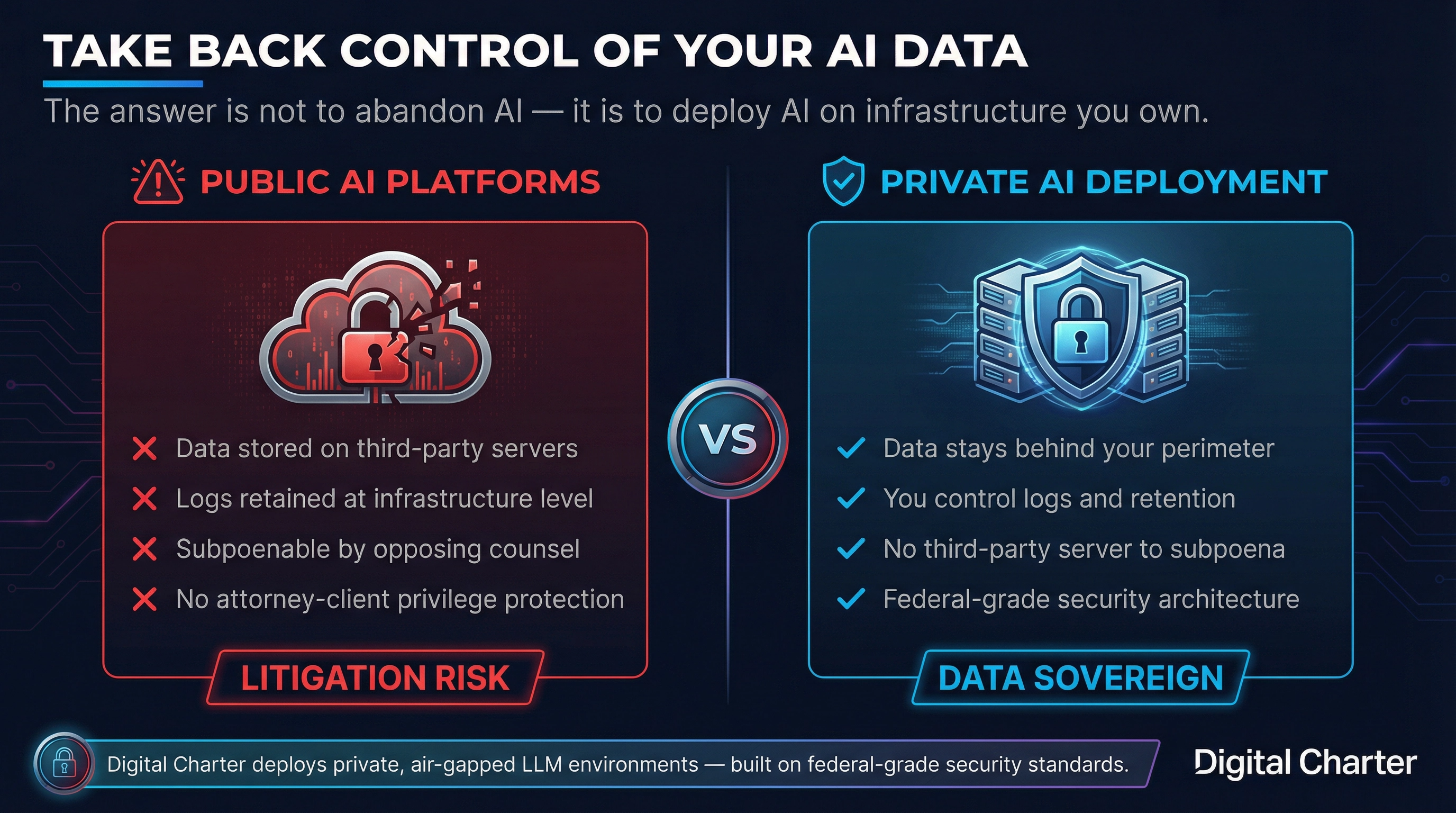
The answer is not to abandon AI. Organizations evaluating AI approaches can account for infrastructure ownership, governance, and data-handling requirements as part of their deployment decisions.
Digital Charter designs AI deployments where sensitive data stays inside a boundary you control.
An AI deployment can be designed around the data boundaries and governance requirements of the organization using it.
Is Your AI Stack Litigation-Ready?
Digital Charter's AI Risk Assessment for Government Contractors reviews AI use involving CUI, proposal, and capture data, with a written report and controlled-deployment roadmap.