
Hire a Person, or Give Your Best Engineers More Tokens?
Every quarter a services firm faces the same decision with large consequences. There is now a second door, and for most firms it is the better one.
The most useful version of the AI question is not strategic. It is a line item.
Every quarter a services firm faces the same small decision with large consequences. There is room in the budget for more capacity. The reflex, built into the DNA of every professional services company, is to hire. More work means more people. The org chart grows, the bench grows, and growth gets measured in heads.
There is now a second door, and for most firms it is the better one. Take the same marginal dollar and spend it on your best engineers: more compute, better tooling, a larger AI budget pointed at the people who already produce your best work. The question "should we hire, or should we give our top people more tokens" sounds abstract until it is sitting in the budget. It is the most practical form of the AI question, and most firms are answering it on instinct rather than on math.
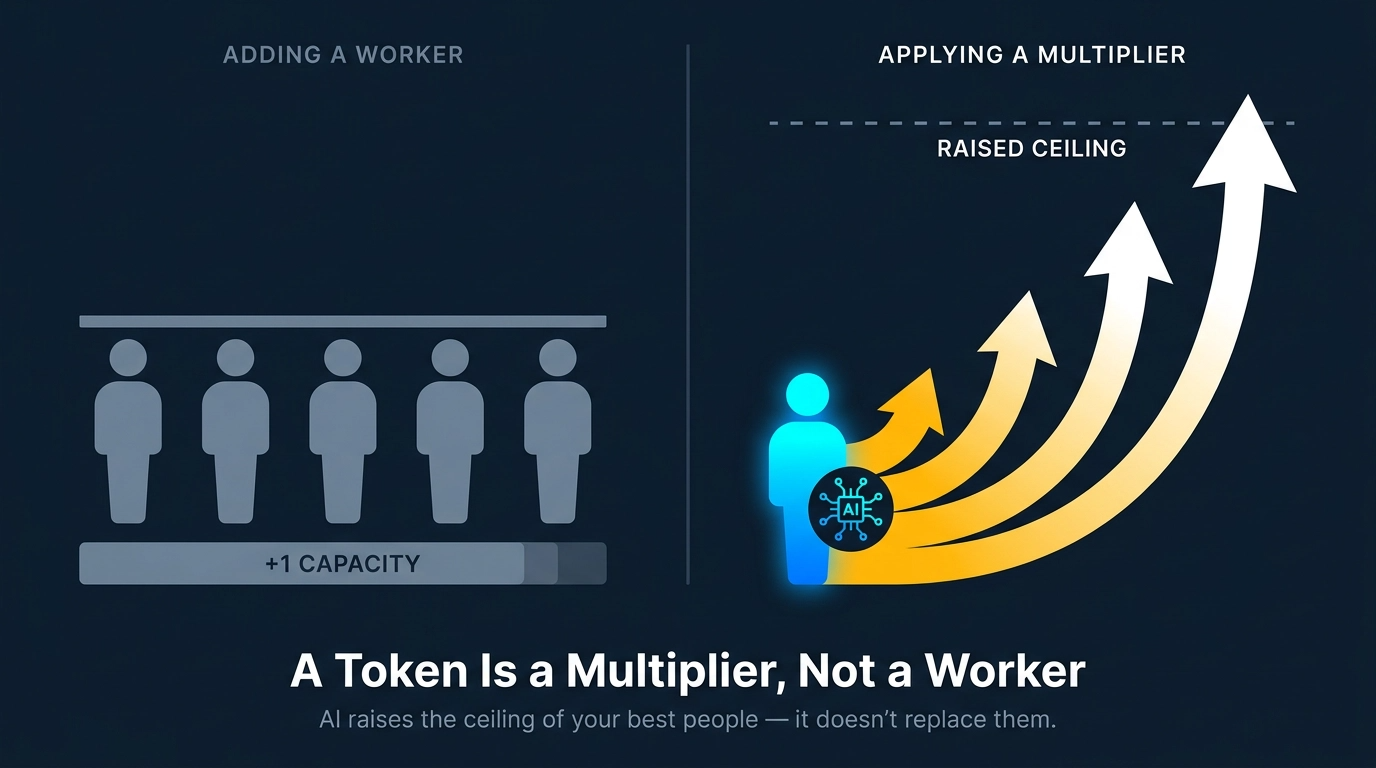
A Token Is a Multiplier, Not a Worker
The mistake is to treat AI as a cheap junior employee. It is not a worker. It is a multiplier, and multipliers behave differently from workers. A new hire adds their own ceiling to the firm. A multiplier raises the ceiling of whoever it is applied to.
Apply that multiplier to an average engineer and you get a somewhat faster average engineer producing output they cannot fully evaluate. Apply it to your best engineer — the one who already knows what good looks like — and you get a compounding return, because that person can direct the model, catch its mistakes, and reject what does not meet their standard.
This is the counterintuitive part. AI does not close the gap between your great engineers and your average ones. It widens it. The leverage flows to the people with the judgment to use it, which means the highest-return move is usually to concentrate it on the few rather than spread thin hiring across the many.
The Body Costs More Than the Salary
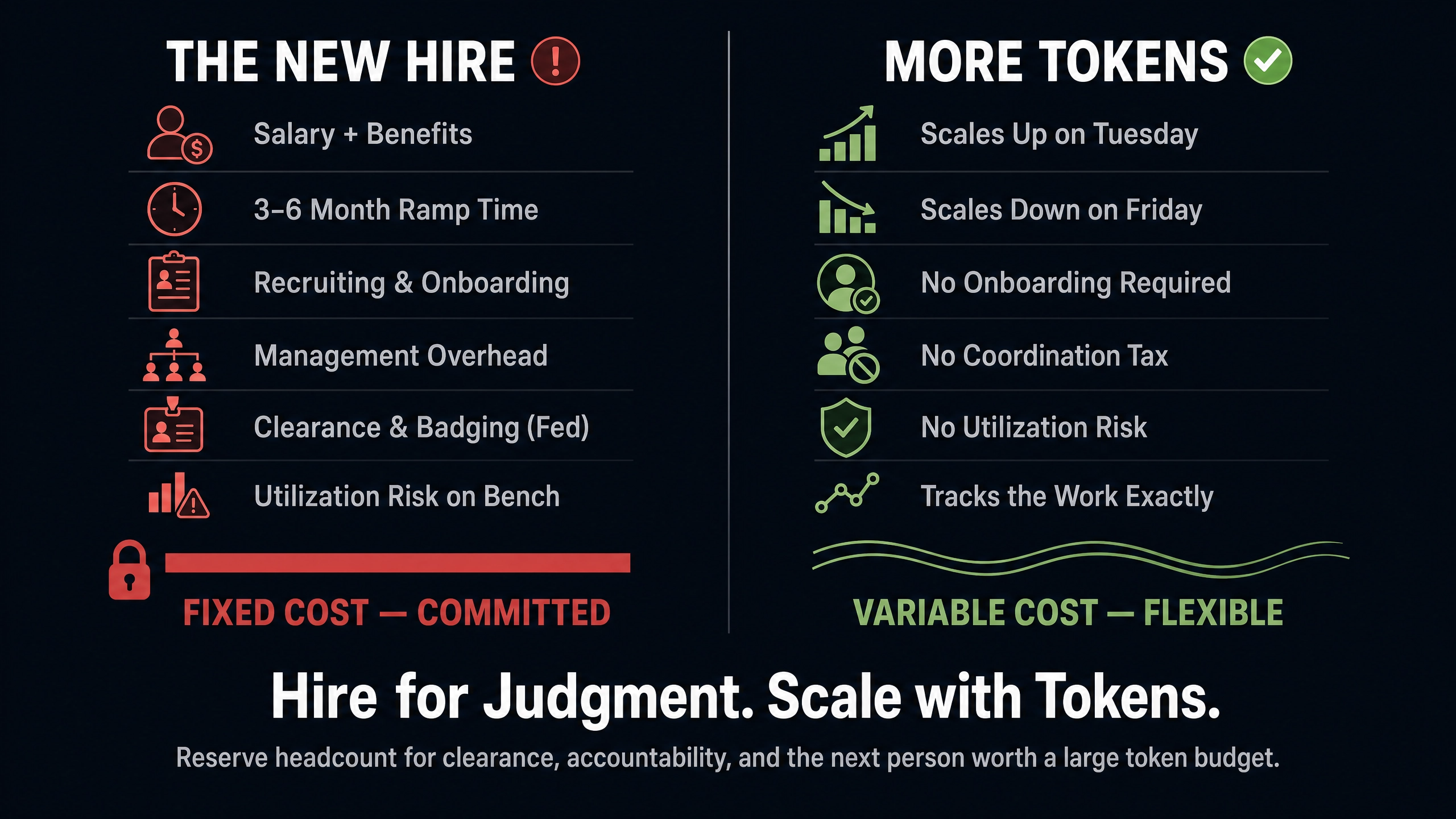
A new hire is the salary plus everything around it. Recruiting. Three to six months of ramp before real productivity. Management attention. Benefits and overhead. The communication cost that grows with every person added, so that the tenth hire makes everyone slightly slower, not just the team slightly larger. In federal work, onboarding and coordination add to that investment, along with the need to keep work aligned between contracts.
Tokens carry none of that. They scale up on a Tuesday and down on a Friday. There is no onboarding, no standup, no coordination tax, no utilization risk. A body is a fixed commitment. A token is variable cost that tracks the work exactly. For a firm trying to stay lean while delivering more, that difference is most of the game.
Where You Still Have to Hire
This is not an argument for one genius and a credit card. A firm run that way is fragile and has no future.
Some responsibilities still require people. A model cannot be the accountable name a contracting officer needs. It does not provide redundancy when your best engineer is on leave or walks out the door, and a firm with a bus factor of two is one bad week from a crisis. There is also a ceiling on how much model output a single person can responsibly review, and past it, more tokens stop helping. And every firm has to grow its next generation of senior judgment — that only happens through exposure, not through watching a model produce output.
So the honest answer is not "never hire." It is "hire for different reasons."
Hire Heads, Not Hands
The role AI is erasing is the junior engineer as a production unit — the person you hired for raw output. The role that grows is the person who can direct and supervise that output well enough to stand behind it. When you hire now, hire for judgment, for the ability to point a model at a hard problem and know whether the answer is right. Hire heads, not hands.
The default has flipped. For pure capacity, give your best people more tokens before you add another body, because the multiplier on a high base beats the addition of an average one almost every time. Reserve hiring for accountability, redundancy, and the next person worth handing a large token budget to.
The firms that internalize this will run smaller, move faster, and keep more of what they earn. The ones still answering "hire" by reflex will spend the next decade carrying a cost structure their competitors learned to shed.