
Vibe Coding Widens Your Attack Surface. Here's What "Make It Secure" Actually Misses.
You scaffolded an app in an afternoon. The model audited it and came back confident. What it missed is exactly where attackers look first.

You scaffolded an app in an afternoon. The UI works. The API responds. You typed the prompt everyone types:
"Run a security scan and make sure my app is secure."
The model came back confident. It flagged a few things. You fixed them. You shipped.
What you may not know is that the scan was not a scan. It was a read-through. And what it missed is exactly where attackers look first.
The Illusion of Coverage
Foundation models are good at pattern recognition on code they can see. When you ask them to audit your application, they will find obvious issues in the logic you wrote: unvalidated inputs in an express route, a missing auth check on an endpoint, a hardcoded string that looks like a secret.
That is real value. But it is not a security posture.
A production application has three layers that a prompt-based review routinely misses:
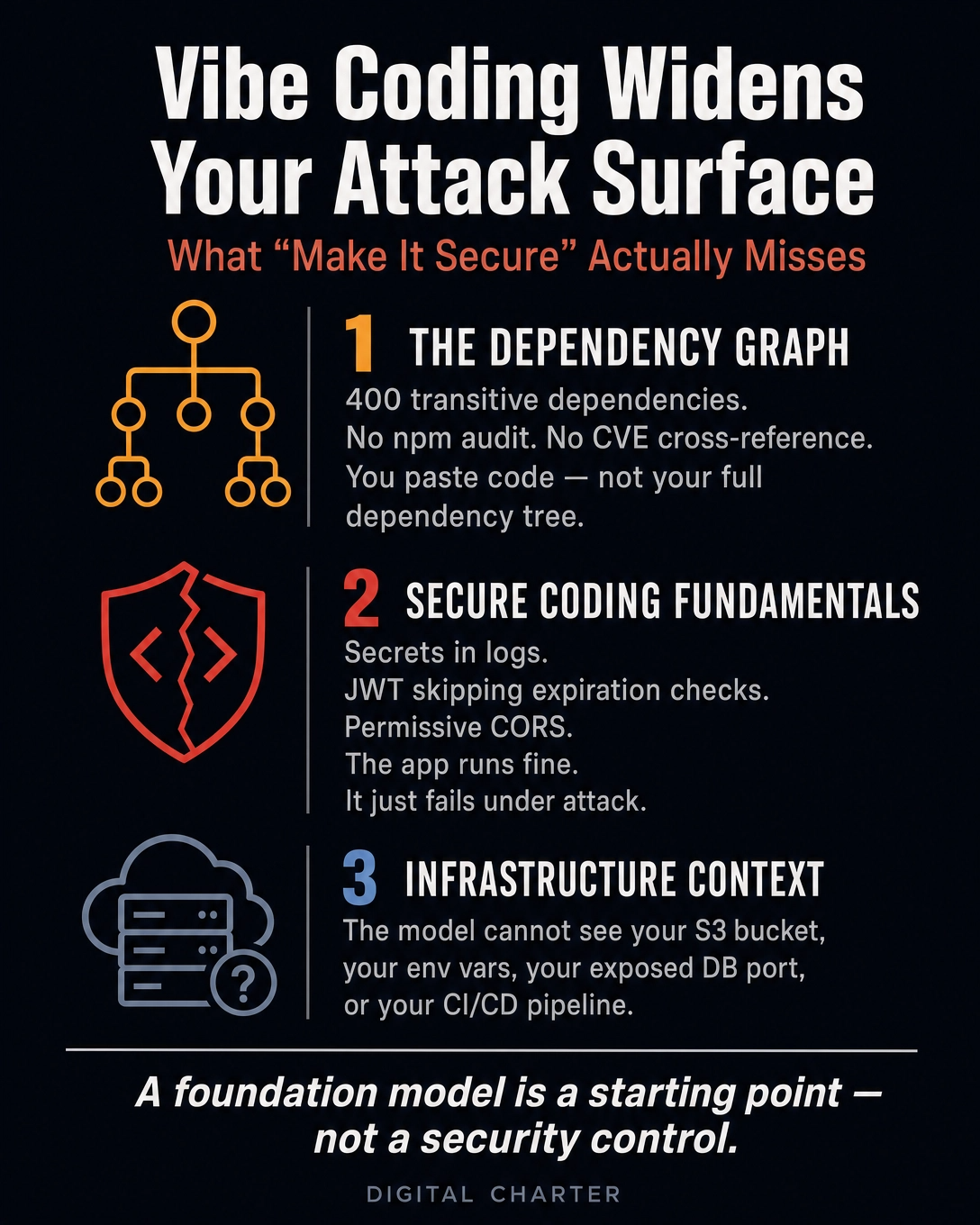
1. The dependency graph
Your app may have 40 lines of business logic and 400 transitive dependencies. Foundation models do not run npm audit or pip-audit. They do not cross-reference your package-lock.json against the CVE database. They read what you paste, and you almost never paste your full dependency tree.
The OWASP Top 10 has included vulnerable and outdated components as a top-tier risk category since 2013. Vibe coding accelerates the adoption of packages without accelerating the hygiene around them. You install a library because the model suggested it. You do not audit that library's supply chain.
2. Secure coding fundamentals at the system level
There is a difference between code that works and code written to a security baseline. Foundation models will produce functional code that fails basic secure development lifecycle standards:
- Secrets surfacing in logs via verbose error handlers
- JWT validation that checks signature but skips expiration or audience claims
- SQL query construction that uses parameterization inconsistently across routes
- CORS configurations that are permissive by default and never tightened
- Session management that works for demo traffic and breaks under adversarial conditions
These are not bugs. The app runs fine. They are structural vulnerabilities that emerge from the model optimizing for "it works" rather than "it holds under attack."
3. Configuration and infrastructure context
The model has no visibility into how your app is deployed. It does not know whether your S3 bucket is public, whether your environment variables are scoped correctly in your hosting platform, whether your database port is exposed to the internet, or whether your CI/CD pipeline has secret scanning enabled.
Asking the model to "make it secure" without infrastructure context is asking someone to audit the locks on your doors without knowing whether your windows are open.
Platform Security Tools Are Not the Answer Either
Some vibe coding platforms have started shipping built-in security features. Dependency warnings. Basic secret detection. Automated suggestions to patch flagged packages. The intent is right. The execution is nowhere close to sufficient.
What these tools provide is coverage theater. They catch the obvious, they miss the structural, and they give the builder one more reason to feel like the bases are covered. That is more dangerous than no tool at all.
More importantly, none of this changes what was actually built. A vibe-coded app is a rapid prototype. It was optimized for speed and demonstration, not durability or defense. Platform security tooling layered on top of a poorly architected codebase does not produce a secure application. It produces a slightly less obviously broken one.
The honest framing: these platforms are useful for validating a concept, showing a stakeholder something real, or moving fast in a low-stakes environment. That is the ceiling. Treating a vibe-coded prototype as a production system because the platform flagged zero critical issues is a category error. And that category error is how data leaks happen.
No prototype velocity is worth a breach. Not one.
Why This Matters More Now
The attack surface created by vibe coding is not just the individual app. It is the pattern at scale.
When a solo founder or small team can go from zero to deployed in 72 hours, they often also go from zero to vulnerable in 72 hours. The speed is real. The security shortcuts are real. And because the output looks polished and the model sounded confident, the false sense of coverage is also real.
Security teams at agencies and enterprises are already tracking this. Applications built on AI-assisted scaffolding are arriving in production environments with dependency chains that were never reviewed, secrets that were never rotated, and infrastructure configs that were never hardened.
The model did not ship a security gap intentionally. It just does not know what it does not know about your environment.
What Closing the Gap Actually Looks Like
A foundation model is a starting point, not a security control. Real coverage requires:
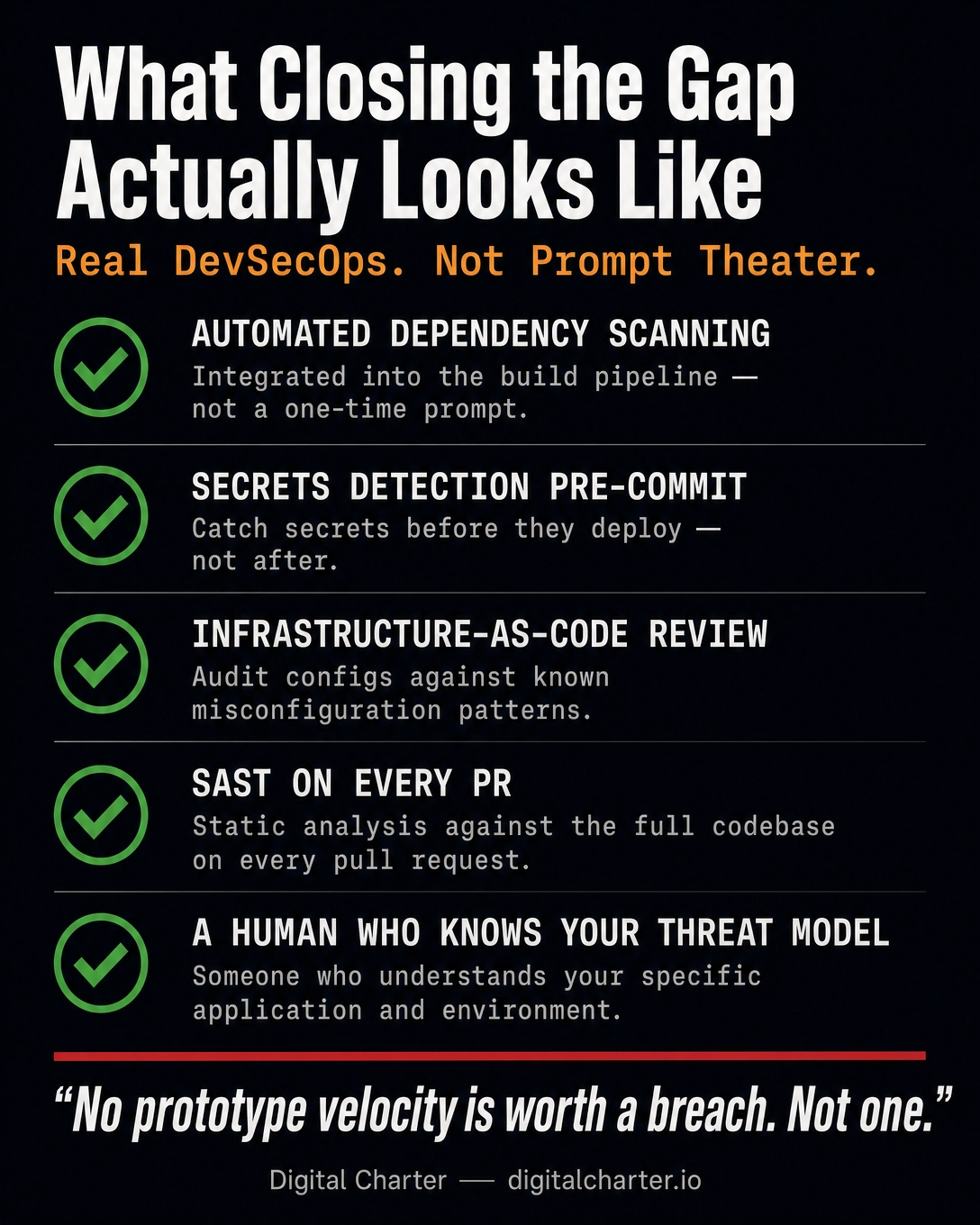
- Automated dependency scanning integrated into the build pipeline, not a one-time prompt
- Secrets detection pre-commit, not post-deploy
- Infrastructure-as-code review against known misconfiguration patterns
- SAST tooling that runs against the full codebase on every PR
- A human who understands the threat model for your specific application and environment
Vibe coding is not going away. The velocity is too useful to abandon. The answer is layering real DevSecOps practice on top of AI-assisted development, not trusting the model's confidence as a proxy for security assurance.
Digital Charter helps organizations that built fast figure out where they actually stand, and what it takes to operate in environments where security is not optional.